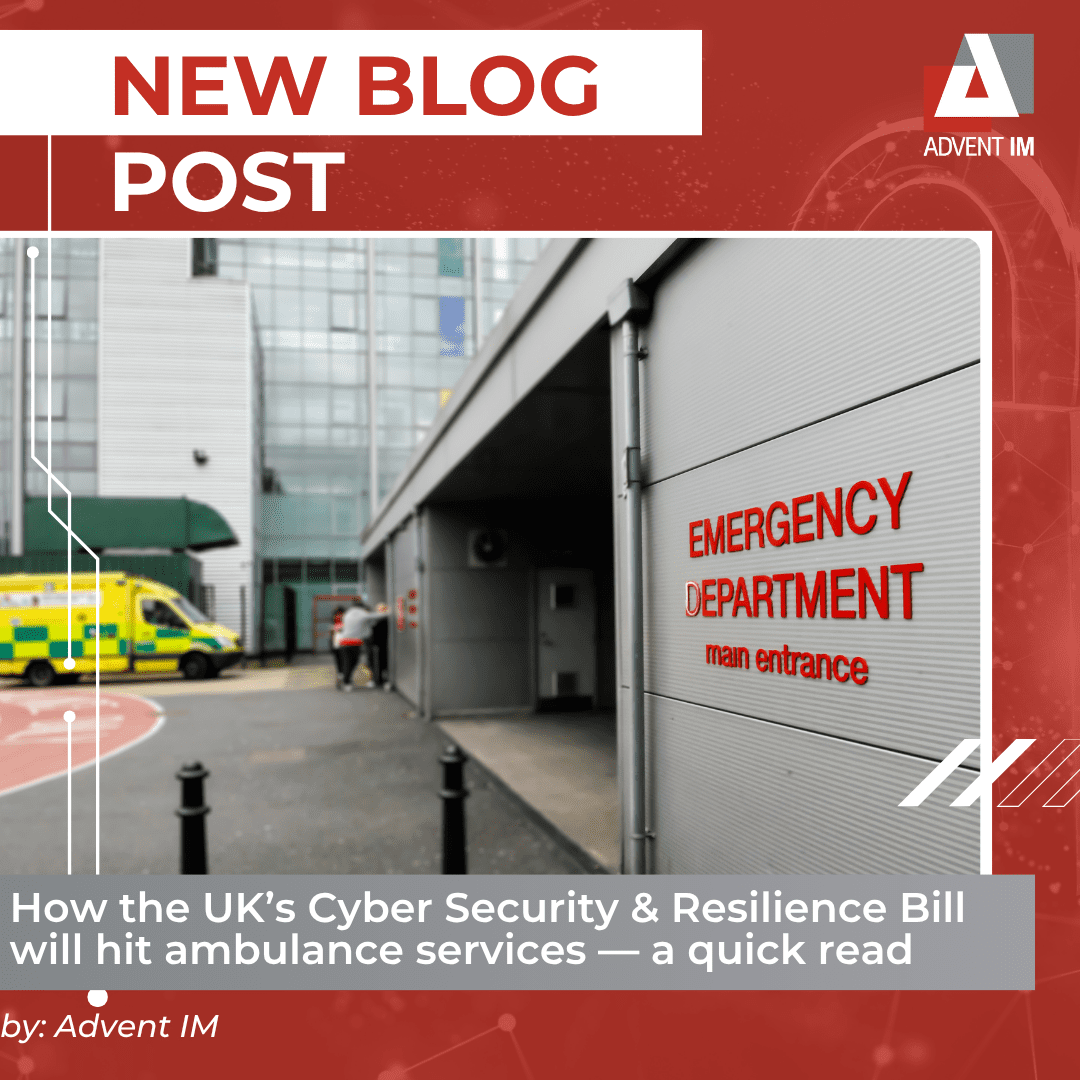
How the UK’s Cyber Security & Resilience Bill will hit ambulance services — a quick read
News and information from the Advent IM team.
Ambulance trusts run at the sharp end of healthcare: life-or-death decisions, stretched resources and a heavy reliance on digital systems for dispatch, patient records and remote monitoring. The new Cyber Security & Resilience Bill (CSRB) — recently introduced into Parliament — is designed to harden the UK’s public services against escalating cyber threats. For ambulance services, this isn’t theoretical policy-speak: it will change how you select suppliers, how quickly you report incidents, and how you future-proof encryption for years to come.
One of the Bill’s clearest aims is to bring systems and providers that support essential services under much tighter oversight. If you rely on third-party dispatch platforms, connected medical devices, or cloud-hosted EPRs, expect far stronger expectations for evidence that those systems meet the mandated security baselines. The Bill also widens the scope of who authorities can scrutinise — not just the ambulance trust itself, but critical digital partners with “trusted network access.” That means procurement teams will need to treat supplier security posture as a frontline clinical risk, not an IT checkbox.
A major operational change is the tightening of incident reporting. The government proposes an initial, “light-touch” notification to regulators and the NCSC within 24 hours, with a fuller incident report expected within 72 hours. For ambulance services that already juggle clinical incident reporting and care continuity, this compresses the window to gather technical detail and execute response actions while operations are still under strain. Expect new internal playbooks: immediate containment + a rapid “what we know” brief for regulators, followed by a more complete technical timeline.
The Bill gives authorities the power to designate certain suppliers as “critical” — and then require them to meet statutory cyber standards. Vendors that provide essential functionality (e.g., patient data platforms, telematics for ambulance fleets, clinical decision support) could be required to demonstrate regular security testing, secure engineering practices and incident readiness. That raises the bar across the supply chain: procurement teams should build supplier assurance (security questionnaires, independent pen tests, contractual SLAs) into every tender and renewal. Non-compliance could bring serious regulatory consequences.
The Bill dovetails with the NCSC’s roadmap on post-quantum cryptography (PQC). The message is clear: protect today’s sensitive collections with an eye to tomorrow’s crypto threats. For ambulance services that handle patient identifiable information and telemetry, planning for cryptographic agility — the ability to swap algorithms without wholesale system replacement — will be essential. The NCSC recommends organisations begin migration planning now, with high-risk systems targeted for earlier adoption of quantum-resistant algorithms. Start mapping where keys live, where long-term confidentiality matters, and which devices can be updated remotely.
Inventory & supplier map: Know which vendors have trusted network access and which systems are critical to patient safety.
Update incident playbooks: Build a 24-hour “regulatory notification” feed into your incident response — even if the technical investigation is ongoing.
Raise procurement standards: Add statutory-level security clauses, right-to-audit language and proof-of-testing to contracts.
Start crypto-mapping: Locate encryption dependencies and plan for cryptographic agility and PQC migration where data confidentiality is long-lived.
Communicate clinically: Translate supplier and cyber risk into clinical impact statements for executives and boards.
The CSRB is a dose of realism: it recognises that modern ambulances are as much digital platforms as they are vehicles. The Bill isn’t just about fines and compliance — it’s about making sure patient care can continue safely when the unexpected happens. For ambulance services, the window to prepare is open now: treat the Bill as a catalyst to reframe supplier risk as clinical risk, tighten your reporting muscles, and start the long game on encryption. If you start these steps today, you’ll be ahead of both regulators and adversaries tomorrow.